
In the last two years, the digital marketing world hasn’t just evolved—it has been entirely rewritten. We have moved past the “AI hype” phase and entered the Era of Execution. If your brand is still measuring success solely through traditional SEO rankings and click-through rates, you are looking at a map of a world that no longer exists.
Here is the definitive guide to mastering digital marketing in an AI-saturated landscape.
1. Beyond SEO: Dominating Generative Engine Optimization (GEO)
The most significant shift in 2026 is the transition from Search Engine Optimization to Generative Engine Optimization (GEO).
Search engines like Google and Bing have largely replaced the “list of links” with synthesized, AI-generated answers. Users no longer ask “best running shoes”; they ask their AI, “I’m training for a marathon in a rainy climate and have flat feet—what should I buy and where is the best deal today?”
How to Win at GEO:
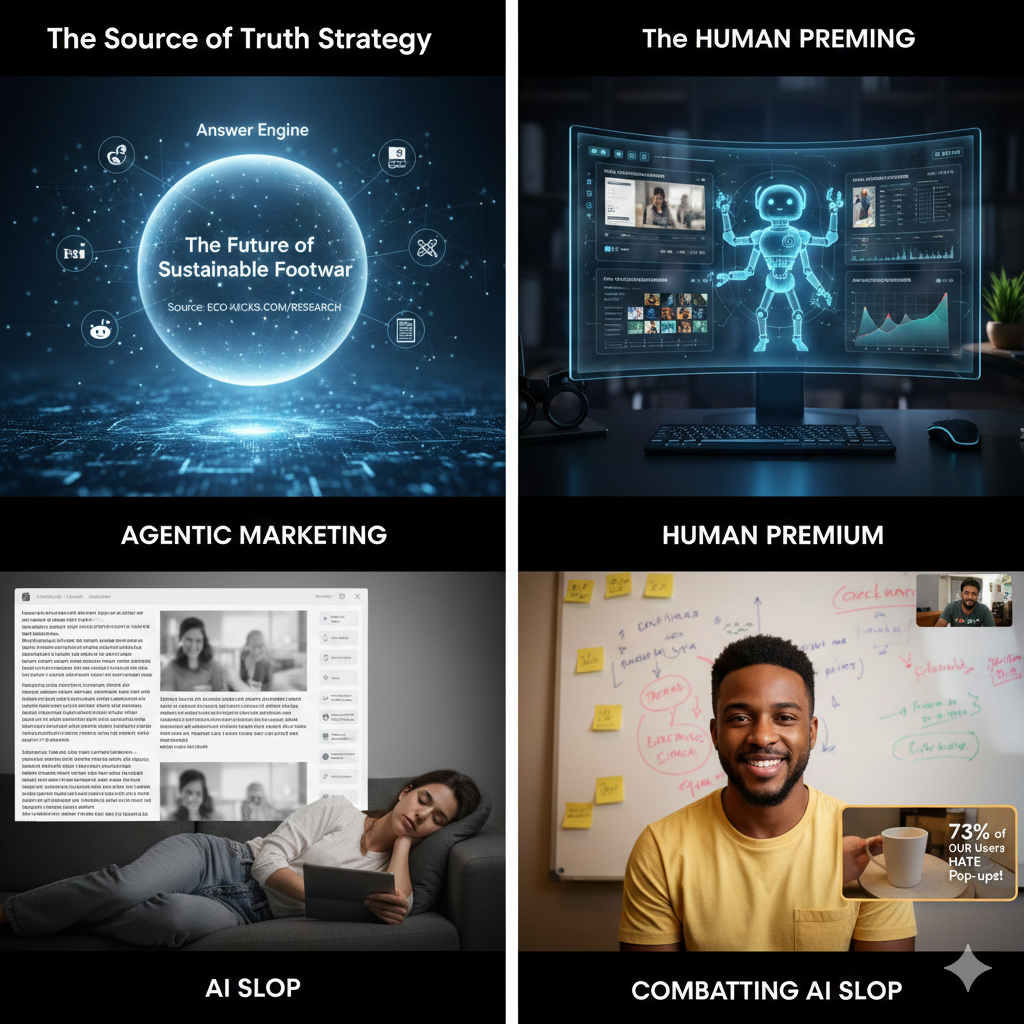
- The Source of Truth Strategy: AI models prioritize “citable” data. To be the answer, your content must include original research, unique statistics, or proprietary case studies that the AI cannot find elsewhere.
- Structured Data 2.0: Technical SEO now requires deep schema marking. You aren’t just telling a bot what your page is about; you’re providing a structured knowledge graph that an AI can ingest and relay to a user.
- Brand Sentiment as a Ranking Factor: AI models “read” the internet’s opinion of you. Mentions on Reddit, niche forums, and professional reviews carry more weight than a thousand low-quality backlinks.
2. The Rise of “Agentic” Marketing
We’ve moved beyond simple chatbots. In 2026, we use AI Agents. Unlike traditional automation that follows a linear “if-this-then-that” logic, agents are goal-oriented.
The Agentic Workflow: You give an agent a goal—“Increase my conversion rate for Gen Z users by 15% this month”—and the agent autonomously analyzes your site, tweaks the ad copy, generates new video variations using Nano Banana, and reallocates the budget in real-time based on hourly performance.
Key Tools for the Modern Marketer:
| Function | AI Tool Category | Impact |
| Content Creation | Multimodal LLMs | Generates text, voice, and video in one prompt. |
| Customer Insights | Predictive Analytics | Identifies churn risks 30 days before they happen. |
| Media Buying | Autonomous Bidders | Real-time budget shifts across 50+ platforms. |
3. The “Human Premium”: Combatting AI Slop
By mid-2026, the internet has become flooded with “AI Slop”—generic, uninspired content generated in seconds. As a result, consumers have developed a “BS filter” for AI-sounding prose.
To stand out, brands must lean into the Human Premium. This means:
- Opinionated Content: AI is trained to be neutral. Humans win by taking a stand, sharing a unique perspective, or using humor that feels authentic and slightly “unpolished.”
- Proof of Persona: Video content is king because it proves there is a human behind the brand. Behind-the-scenes footage and unscripted “founder stories” are the highest-converting assets this year.
- Zero-Draft Innovation: Use AI to build the skeleton of your blogs, but ensure a human adds the “marrow”—the lived experience and emotional resonance.
4. Hyper-Personalization: The “Segment of One”
In 2026, “Personalization” is no longer just putting a first name in an email. It is Dynamic Experience Generation.
Imagine a customer landing on your website. The AI recognizes their past purchase behavior, their current local weather, and their “browsing mood.” It then re-renders the website’s UI in real-time:
- For the “Hurry” Shopper: A minimalist, text-based interface with a “One-Click Buy” button.
- For the “Researcher” Shopper: A deep-dive video comparison and long-form reviews.
This “Segment of One” approach reduces friction and makes the customer feel understood rather than targeted.
5. Visual and Voice: The New Entry Points
With the mainstream adoption of smart glasses and advanced voice assistants, “typing” is becoming a secondary input.
- Visual Search: Every product image must be a high-fidelity data point. Users are snapping photos of items in the street and asking their AI to find “the sustainable version of this.”
- Conversational Commerce: Shopping is moving into the “Ear-space.” Designing for voice means creating content that sounds natural when read aloud and ensuring your brand has a distinct “Sonic Identity.”
Summary: The 2026 Checklist
To thrive this year, your marketing department should look less like a factory and more like a laboratory.
- Pivot to GEO: Stop chasing keywords; start chasing authority and citations.
- Deploy Agents: Move from manual task management to goal-oriented AI agents.
- Humanize: Double down on video and “un-AI-able” opinions.
- Personalize: Move toward dynamic, real-time website experiences.
The future of marketing isn’t about the loudest voice; it’s about the most helpful, most human, and most accurately targeted one.